
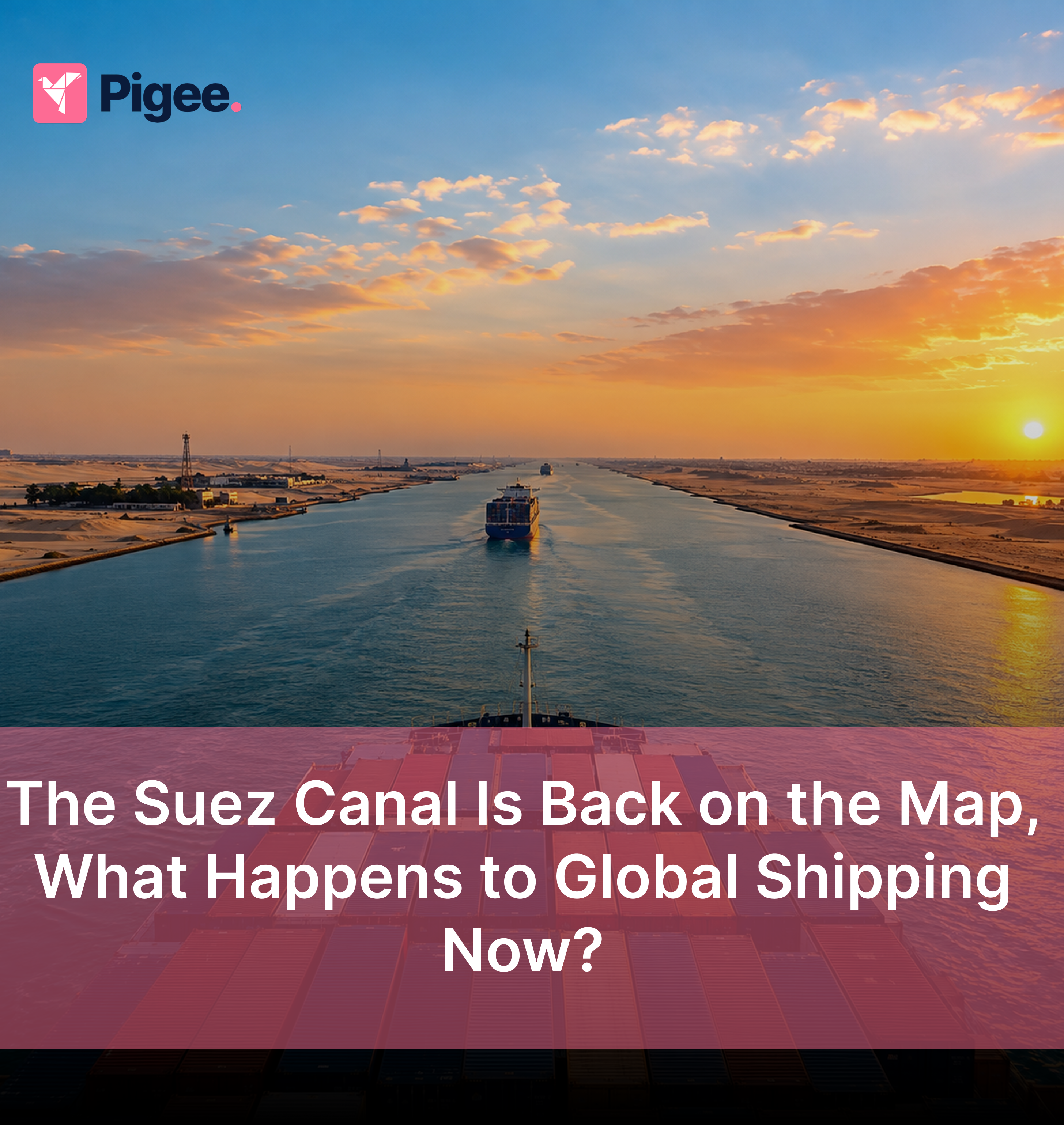

For the past few years, shipping between Asia and Europe has had to take the long way around.
Now, some major carriers are starting to turn back.
On September 14, 2026, Maersk and Hapag-Lloyd announced that four additional services will return to the Suez Canal route,
joining two Gemini services that had already resumed trans-Suez sailings.
The services connect major markets across Asia, Europe, the Mediterranean and the Middle East.
So, is the Suez Canal officially back?
Not quite.
But something important is changing.
Why did ships leave the Suez Canal?
The Suez Canal is one of the world’s most important shipping routes.
It connects the Mediterranean Sea to the Red Sea, creating a much shorter maritime route between Asia and Europe.
But security concerns in the Red Sea led many container carriers to avoid the corridor and instead send vessels around the Cape of Good Hope in southern Africa.
That detour added significant sailing distance and time to some Asia-Europe journeys.
For businesses, that could mean longer delivery times, additional fuel costs, changes in freight rates and more uncertainty around inventory planning.
Now carriers are gradually testing a return to the shorter route.
Maersk and Hapag-Lloyd say their decisions follow assessments of the security situation,
but they are also making clear that the situation remains unpredictable.
If conditions deteriorate, services could be moved back to the Cape of Good Hope.
What has changed in September?
This is where the story gets interesting.
On September 14, Maersk and Hapag-Lloyd announced that four more Gemini services, AE5, AE11, AE12 and ME2, will switch from the Cape of Good Hope back to the trans-Suez route.
The changes begin with September sailings, with the first westbound departures for AE11 and ME2 scheduled for September 19 and AE5 for September 21.
These aren’t minor routes.
For example, AE5 connects Asia with Northern Europe, while AE11 and AE12 connect Asia with the Mediterranean. ME2 connects India with Europe.
That means the impact could extend across several major trade lanes.
But it is important not to interpret this as a complete return to normal.
The shipping industry is still watching the Red Sea closely.
What could this mean for businesses?
The biggest potential change is transit time.
Sailing through the Suez Canal is significantly more direct than going around the southern tip of Africa.
Maersk says its earlier return to the trans-Suez route improved transit times on the MECL service by an average of seven days westbound and 14 days eastbound.
For a large retailer moving thousands of containers, that difference can have a major operational impact.
But smaller businesses should pay attention too.
If you’re importing stock, exporting products or selling internationally, shipping routes can affect:
- – Delivery estimates
- – Inventory planning
- – Freight costs
- – Customer expectations
- – Stock availability
- – Shipping options
A change in the route doesn’t just affect the vessel.
It eventually reaches the business and the customer.
Does this mean shipping will become cheaper?
That’s harder to answer.
More vessels returning to the shorter Suez route could change available shipping capacity
and operating costs, but freight prices depend on much more than distance.
Demand, capacity, fuel costs, port congestion, geopolitical risks and seasonal volumes all influence the final price.
So businesses shouldn’t assume that a Suez return automatically means cheaper shipping.
Instead, the lesson is about flexibility.
When global shipping routes change, businesses need the ability to compare options and adjust quickly.
The bigger lesson, global shipping is not static
One of the biggest mistakes a business can make is treating an international shipping route as something permanent.
It isn’t.
A security incident can change it.
A drought can affect another route.
A port can become congested.
A new customs rule can change the cost of importing into a market.
And suddenly, the route or shipping option that worked perfectly six months ago may no longer be the best fit.
That’s why visibility matters.
Businesses need to know what’s happening before they make promises to customers.
How Pigee can help.
For businesses shipping internationally, the challenge isn’t simply finding a way to move a parcel.
It’s understanding the options available and managing the information around the shipment.
Pigee helps businesses simplify international shipping by bringing together shipping options, customs information, shipment details, payments and tracking in one experience.
That becomes particularly useful in a world where shipping conditions can change quickly.
A business shouldn’t have to completely rethink its international operations every time a major shipping route changes.
It should have the visibility to understand its options and make informed decisions.
Create a free account here to get started.
So, is the Suez Canal back?
Parts of it are. But the story is still developing.
Maersk and Hapag-Lloyd are gradually returning more services to the trans-Suez corridor, while continuing to monitor the security situation.
For global businesses, the takeaway isn’t simply “ships are going back through Suez.”
It’s this:
The route your goods take can change and your shipping strategy needs to be flexible enough to change with it.
Because in global logistics, the shortest route isn’t always the route you can use.
And sometimes, the route you thought was gone can come back.
Want to make international shipping easier to manage?
Explore Pigee and see your shipping options.


